



In April 2024, Catalina Saldías Innocenti, working at EnBW Energie Baden-Württemberg AG – one of the largest integrated energy companies in Germany and Europe – began using Geoscience ANALYST Pro. This tool was introduced to streamline subsurface interpretation, integrate diverse datasets, and fully leverage 3D visualization.
A Seamless Fit with Existing Tools
Catalina and her team rely on a range of geoscience software to meet different technical needs. QGIS supports detailed geospatial mapping, while OpenDtect excels in seismic interpretation. However, each has its limitations:
-
QGIS offers excellent map-based visualization but lacks 3D capabilities.
-
OpenDtect is powerful for working with seismic horizons and faults but can be less intuitive, with more specific file handling requirements.
Geoscience ANALYST Pro fills the gap, offering a unified workspace that connects 2D and 3D data and simplifies complex workflows.
”What I appreciate most about Geoscience ANALYST Pro is its advanced visualization capabilities and the ability to easily combine 2D and 3D datasets. Importing and exporting files is simple, creating surfaces from points (and vice versa) is smooth, and the interpolation and gridding tools for raster and GRD files are particularly valuable for processing gravity data.
—Catalina Saldías Innocenti at EnBW
Enabling Smarter Collaboration
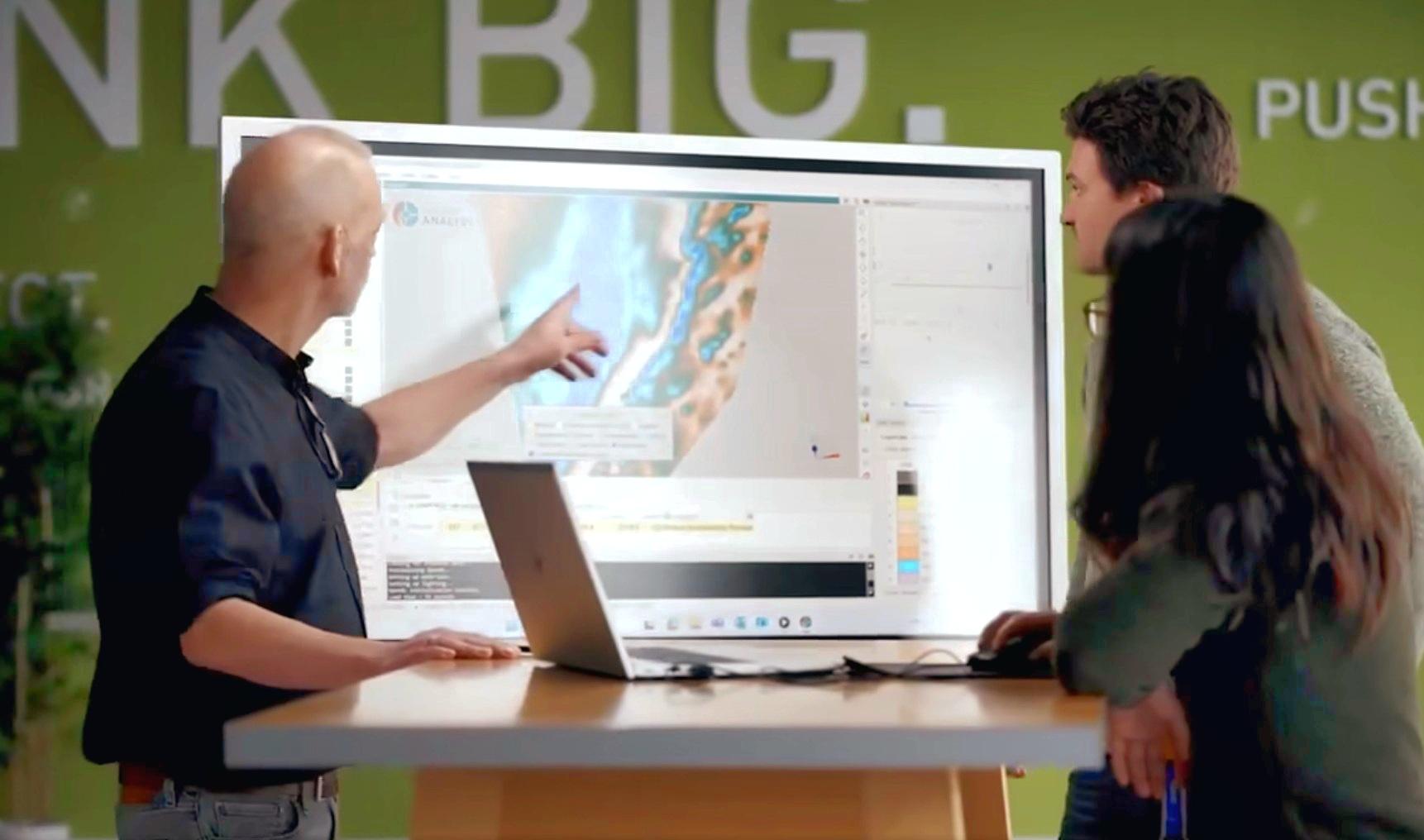
Beyond its technical capabilities, Geoscience ANALYST Pro is improving collaboration within the team. With a single portable workspace file in the open GEOH5 format, sharing interpretation progress is easy—making teamwork more efficient across locations or roles.
“Right now, it’s mostly two of us working with Geoscience ANALYST, and sharing progress is smooth—it’s just one workspace file that can be uploaded and passed along.”
This simplicity supports more agile collaboration and ensures that insights can be transferred seamlessly between team members. As more colleagues explore the platform’s capabilities, Geoscience ANALYST Pro is becoming a central hub for subsurface interpretation—unifying efforts and accelerating project timelines.
Favorite Functionalities and Suggestions for Future Development
One standout feature is the ability to work directly with seismic data in 3D:
“I really liked being able to import a SEG-Y 3D cube with specific amplitude values per horizon. We transformed it into reference data and visualized it beautifully in 3D using slicers and cross-sections.”
The team also values the intuitive tools for creating surfaces from point data and the Python integration for advanced customization. At the same time, they see opportunities for growth:
“I would love to be able to build our own 3D models from scratch using 3D horizon data with finer resolution. With the current scripting tools, our dataset was too large for the computing power we had, so we couldn’t create models with refined borders or integrate faults. Maybe that’s a feature in Geoscience ANALYST Pro Geology—we haven’t tried it yet.”
Final Thoughts
Geoscience ANALYST Pro is helping EnBW bridge the gap between 2D mapping, 3D seismic interpretation, and integrated geophysical workflows—empowering users with a flexible, intuitive platform. With growing interest in advanced modelling features, Catalina and her team are well-positioned to continue unlocking the full potential of the Geoscience ANALYST platform.
Meet the Interviewee

Catalina Saldías Innocenti is a Chilean geologist from Universidad Austral de Chile (Valdivia), currently completing her Master’s studies in Applied Geosciences (ERS profile) at the Karlsruhe Institute of Technology (KIT), Germany. She has worked as a research assistant (Hiwi) in the Geoenergy Group at KIT, as a working student at EnBW, and is now conducting her Master’s thesis in the R&D department at EnBW in collaboration with KIT. Her work focuses on geothermal energy, with particular interest in geothermal fluids pathways and circulation.
Please contact our team for additional information about our products and services
Latest news

GEOH5: A Framework for Geoscience Data and Model Portability
Used by thousands, GEOH5 is the open-source data structure that is taking down the interoperability barriers and revolutionizing...

Mira Geoscience receives the 2023 AME Innovation Award
John McGaughey, Mira Geoscience's President, has been selected for the 2023 AME Innovation Award for leading the development of GEOH5.

New release – Geoscience ANALYST 4.6
Geoscience ANALYST 4.6 brings performance improvements and key new features to all modules. Download it now!

Machine learning in mineral exploration
We have applied machine learning as part of custom solutions to complex exploration and geotechnical problems since 2015...

New release – Geoscience ANALYST 4.5
Geoscience ANALYST 4.5 brings performance improvements and key new features to all modules. Download it now!

Filtering samples by their drillhole
In Geoscience INTEGRATOR, you can can filter them according to the drillhole they are located in...

Filtering data by neighbourhood
In the web UI, you can rapidly filter your data by neighbourhoods and display it in plots, charts, or tables.

VPmg, VPem1D and VPutility release
VP Geophysics Suite releases: VPmg version 9.3, VPem1D version 4.3 and VPutility version 1.2...

DC resistivity inversion in Geoscience ANALYST Pro Geophysics
Past event, view here or via our YouTube channel...

Reshape using spiderwebs
GOCAD Mining Suite v19 allows you to reshape your surfaces and 2D Grids with a spiderweb editing tool...

Customize the Viewport axis labels
In Geoscience ANALYST you can customize the Viewport axis labels
..

Generating exploration models from a detailed structural interpretation and Artificial Intelligence
This approach uses the comment field of the logging table to extract general topics that can then be used as learning features in a supervised machine learning classification approach.