




Transient EM (TEM) — also called time-domain EM (TDEM) — is a geophysical exploration method used to map subsurface electrical conductivity. TEM is widely used in mineral exploration, groundwater studies, environmental investigations, and geotechnical work to detect conductive bodies beneath the surface. Traditionally, geophysicists interpret TEM anomalies by modelling them as conductive rectangular plates — an approach that works well in many cases.
However, not all conductors are thin and planar. Many real geological targets — such as massive sulphide bodies — are closer in shape to pods or lenses than to plates. When non-tabular targets are modelled as simple plates, important geological information can be lost.
This is where ellipsoid-based modelling offers an attractive alternative.
Moving Beyond Plates
Instead of assuming the conductive targets are flat plates, ellipsoid modelling represents subsurface conductors as triaxial ellipsoids.
Ellipsoids provide several advantages over rectangular plates when exploring for discrete, high-conductivity mineral targets:
- Greater flexibility – spanning a wide range of conductor shapes
- No edges or sharp corners – making them mathematically more robust to model
- Finite volume – unlike plates, ellipsoids represent a 3D body
Introducing Parametric Ellipsoid Modelling
Parametric is an ellipsoid-based modelling and inversion program, developed by Peter Fullagar at Fullagar Geophysics, for interpretation of TEM data.
The key features of the program are:
- fast modelling and inversion of EM resistive limit and inductive limit data assuming homogeneous triaxial ellipsoid conductors in a resistive host
- inverts 1-, 2- or 3-component airborne, ground, and downhole TEM data
- suitable for both dB/dt and B-field data sets
- suitable for sub-audio magnetic (SAM) “total field” data sets
- the novel resistive limit algorithm (Fullagar, 2024) has been validated against analytic solutions and against Lamontagne MGEM 3D TEM finite-difference modelling software
- computes resistive limit response for ellipsoids which are permeable as well as conductive
- inverts data from multiple Tx loops and multiple downhole profiles or survey lines simultaneously
- can be employed “stand-alone” or used in conjunction with other software, e.g. initial ellipsoid parameter values can be based on VPem3D compact inversion results
- reads VPem3D moment data files
VPem3D and Parametric are now available within Geoscience ANALYST Pro Geophysics. These tools can be accessed as an optional add-on, allowing users to perform rapid TEM modelling and inversion directly within the integrated interpretation environment.
By combining these algorithms with the visualization and data integration capabilities of Geoscience ANALYST Pro Geophysics, geoscientists can efficiently model conductive bodies, test geophysical hypotheses, and refine exploration targets as part of their workflow.
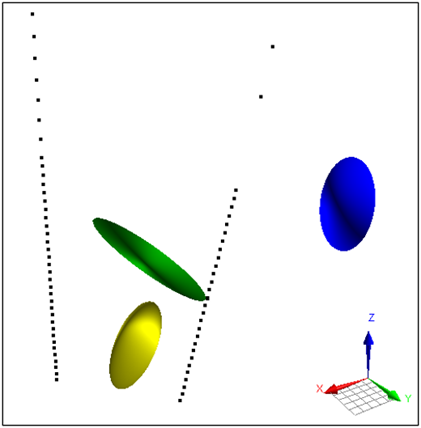
Figure 1. 3D view of conductive ellipsoid model after Parametric inversion of downhole TEM. The conductors were quasi-spherical initially, but assumed quite different shapes during inversion: prolate (green), oblate (blue), and intermediate (yellow).
A Faster Approach to EM Modelling
One of the key strengths of Parametric is speed.
Instead of solving the full 3D electromagnetic equations—which can be computationally demanding—the program uses a magnetostatic algorithm designed for two physical regimes commonly seen in TEM surveys: the resistive limit (RL) at late times and the inductive limit (IL) at early times.
These limits are especially useful for TEM interpretation because:
- Late-time responses often highlight deeper, highly conductive targets
- Early-time responses are characteristic of extremely high conductivity bodies, or provide information about shallower structures
By focusing on these two limits, the algorithm simplifies the physics while still capturing the key behaviour of the conductors.
The RL and IL current distributions inside ellipsoidal conductors are simple in these limits:
- Resistive limit: current increases linearly from zero at the centre to a maximum at the surface of the ellipsoid
- Inductive limit: current is confined to the surface of the ellipsoid
These simplified current distributions permit rapid and accurate calculation of the TEM response.
In practice, Parametric modelling is very fast. Inversion of ~19,000 UAVSAM total-field TEM measurements from Forrestania, Western Australia, involving 12 transmitter loops, was completed in about 1.5 minutes on a standard laptop. Some of the observed and calculated data are shown in the figure below.
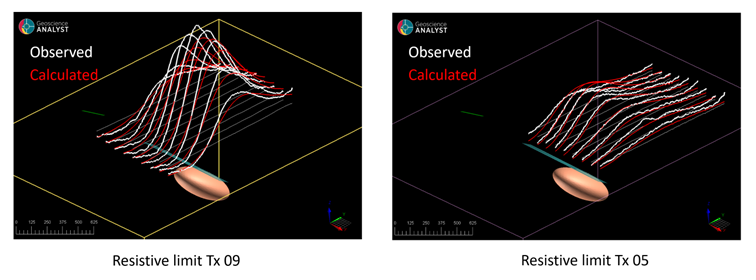
Figure 2. Observed and calculated UAVSAM profiles for two of twelve transmitter loops deployed over the IR4 conductor at Forrestania, Western Australia. Parametric inversion of the data from all 12 Tx loops defined the conductive ellipsoid (beige) as the IR4 source.
How the Inversion Works
The goal of inversion is to find a model that reproduces the measured TEM data.
During inversion, Parametric adjusts the conductivity and/or geometry of the ellipsoid(s) to optimize data fit. Inversion proceeds iteratively.
The inversion is flexible. The user can decide which ellipsoids and which parameters are allowed to change. Inversion is constrained by (optional) parameter minima and maxima prescribed by the user.
Complementing Other EM Inversion Methods
Ellipsoid modelling doesn’t replace full 3D inversions — it complements them.
For example, the starting model for Parametric, i.e. the number of conductors and their initial locations, could be based on a fast, geologically-constrained VPem3D inversion.
More rigorous, time-consuming, full solution 3D inversion could be completed subsequently, if considered necessary. Fast inversions, such as those performed by Parametric and VPem3D, are often more effective than rigorous 3D smooth model inversion for definition of discrete, highly conductive targets.
In practice, ellipsoid modelling provides new options for rapidly evaluating TEM anomalies, and hence for guiding drilling decisions early in exploration programs.
A Practical Tool for Modern Exploration
In mineral exploration, speed and flexibility matter. Ellipsoid-based modelling is a practical approach for exploration teams that need to assess large TEM data sets quickly, offering:
- fast computations
- diverse conductor shapes
- flexible parameter control
- effective for airborne, ground, and downhole TEM data
For many exploration scenarios, conductive ellipsoid modelling provides an effective alternative to plate-based interpretations—especially when dealing with complex, three-dimensional geological targets.
As datasets continue to grow and exploration moves deeper, tools that combine speed, simplicity, and flexibility will play an increasingly important role in understanding the signals hidden within TEM data.
Reference
Fullagar, P.K., 2024, The resistive limit response of an ellipsoidal conductor: a magnetostatic formulation: Exploration Geophysics, 55, 81-98. DOI: 10.1080/08123985.2023.2275804

Peter Fullagar is an exploration geophysicist with more than 40 years experience in mineral exploration, known especially for his development of fast modelling and inversion methods for potential fields and electromagnetic (EM) data. worked in industry (Western Mining Corporation, Rio Tinto Exploration), academia (École Polytechnique de Montréal), and government research (CSIRO). and. He established Fullagar Geophysics Pty Ltd in 1998 and has consulted privately since then. In 2024, he received a Gold Medal Award from the Australian Society of Exploration Geophysicists in recognition of his outstanding contributions to exploration geophysics.