



In modern mineral exploration, transient EM (TEM) surveys generate large volumes of data, but quickly converting those data into reliable models remains a major challenge.
VPem3D, from Fullagar Geophysics, addresses this challenge. It is a fast approximate 3D inversion program for airborne, ground, and downhole TEM data that expedites interpretation, whether geologically-constrained or unconstrained.
VPem3D integrates with other Mira Geoscience tools by operating on the same model files and employing the same inversion styles as VPmg and VPem1D. It can therefore advance combined interpretation of EM, gravity, and magnetic datasets. VPem3D is offered as an optional add-on to Geoscience ANALYST Pro Geophysics.
Magnetostatic Modelling of Moments: A Faster TEM Inversion Approach
A key innovation in VPem3D is its fast forward algorithm which approximates the resistive limit response as a superposition of magnetic dipole fields. This magnetostatic approach simplifies the physics while preserving the essential characteristics of the late time TEM response. VPem3D run times are shorter than conventional 3D TEM inversion run times by a factor of 10 or more. A further increase in speed follows because the resistive limit is a single value at each station. Therefore, one quantity (moment or resistive limit), based on time integration of the measured data, is inverted at each station rather than multiple readings defining a transient decay.
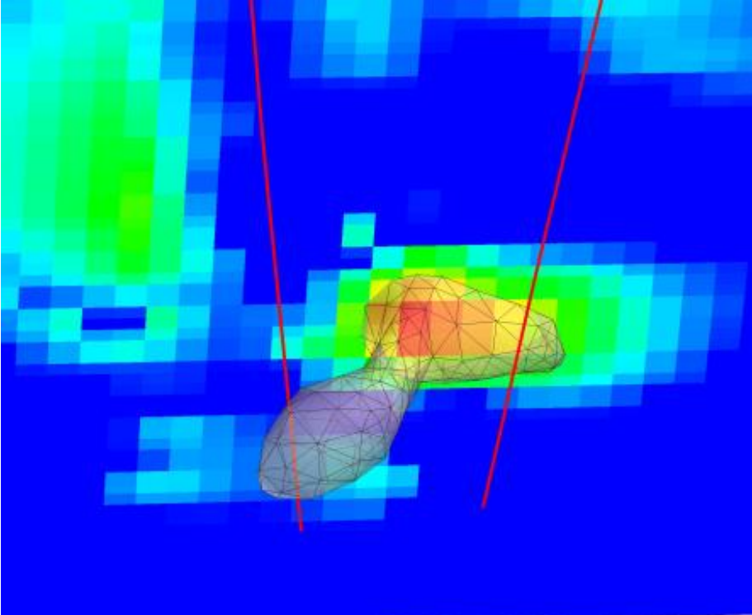
Figure 1. Wireframe of a conductor after VPem3D inversion of downhole TEM at a nickel sulphide prospect: two loops, two holes, and 3 components. Conventional 3D inversion of this data took 2 weeks in 2013; VPem3D defined the same off-hole conductors in 2 minutes.
Flexible Inversion Options
VPem3D is designed to perform both unconstrained and geologically constrained inversion, allowing it to play an important role at all stages of exploration.
It offers three main inversion styles:
- Homogeneous property inversion (optimising the conductivity of individual geological units)
- Heterogeneous inversion, with two sub-types which produce either smooth or high contrast (“compact body”) models
- Contact geometry inversion
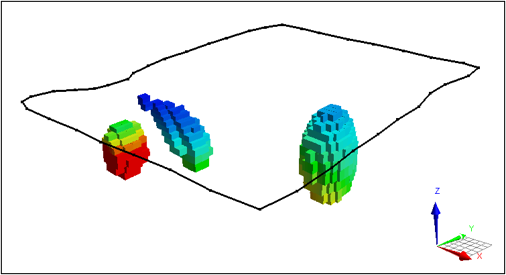
Figure 2. 3D view of discrete conductors defined by VPem3D unconstrained compact body inversion of HeliSAM data recorded over a 1.5km x 1.9km transmitter loop. An initial VPem3D compact inversion can expedite target refinement, e.g. via Parametric ellipsoid-based modelling, by identifying the number of conductors demanded by the data as well as by providing initial estimates of their starting locations and shapes.
VPem3D can handle one-, two-, or three-component TEM data, and supports all common survey geometries, including in-loop and slingram configurations deployed in either fixed-loop or moving-loop surveys. Importantly, ground and downhole datasets can usually be inverted simultaneously, enabling integrated interpretation across survey types.
Geological Model-Based Inversion
Unlike conventional voxel-based inversion approaches, VPem3D can operate directly on geological models. The subsurface is represented as close-packed vertical prisms subdivided horizontally into cells, each of which is assigned to a geological unit. The VPem3D model structure is identical to that used by VPmg and VPem1D.
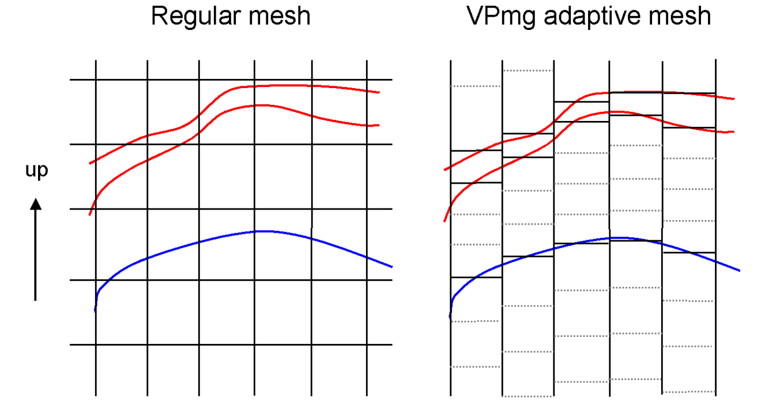
Figure 3. VPem3D mesh adapts to the geology and to the surface topography. Some cell boundaries in the VP mesh (solid black in the diagram) define geological contacts.
The adaptive mesh enables:
- Inclusion or exclusion of geological units during inversion, e.g. only allowing changes within the most prospective unit(s)
- Preservation of sharp geological contacts
- Explicit representation of rock domains and structures
- Inversion with drillhole control
- Conductivity bounds specific to individual geological units
Either conductivity or contact geometry can be adjusted during inversion, allowing flexible but geologically consistent modelling.
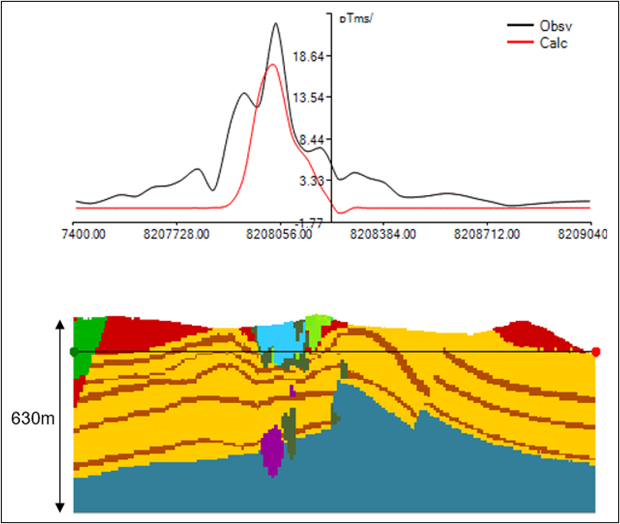
Figure 4: Geologically-constrained VPem3D inversion of moving-loop ground TEM. In this homogeneous unit inversion the changes in conductivity were limited to the two mineralised breccia units, coloured light blue and light green.
When performed on geological models, VPem3D inversions can be constrained by information derived from drill holes, and by weights imposed by the user.
Examples of constraints include:
- Cell boundaries treated as fixed, bounded, or free to move depending on their proximity to drill-hole intersections of geological contacts
- Proximity-based weighting that damps model perturbations near drill hole pierce points
Together, these features allow the user to honour known geology, making VPem3D particularly effective in mature exploration environments with extensive drilling.

”VPem3D allows very fast simultaneous modelling of data from multiple transmitters with multiple conductors, a very difficult task using most EM interpretation programs. VPem3D models typically run in a matter of minutes on a laptop, and are a very quick way of determining the number and positions of conductors in a survey area. The VPem3D models may be used in their own right, or can form the starting point for interpretation using other EM modelling codes.
James Reid, PhD, Director, Consulting—Asia Pacific at Mira Geoscience
Conclusion
VPem3D expedites faster inversion of TEM, whether unconstrained or constrained by geology.
Because VPem3D inversion is computationally efficient, multiple scenarios can be tested rapidly. Because it can perform inversion on a geological model, VPem3D is able to play an important role at all exploration stages.
References
Fullagar, P.K., Pears, G.A., Reid, J.E., & Schaa, R. (2014). Rapid approximate inversion of airborne TEM. Exploration Geophysics, 46(1), 112–117. https://doi.org/10.1071/EG14046
Fullagar Geophysics (2024). VPem3D User Documentation (v3.400). https://www.fullagargeophysics.com/downloads/documentation/VPem3D_documentation_v3.400_Aug2024.pdf

Peter Fullagar is an exploration geophysicist with more than 40 years experience in mineral exploration, known especially for his development of fast modelling and inversion methods for potential fields and electromagnetic (EM) data. Peter worked in industry (Western Mining Corporation, Rio Tinto Exploration), academia (École Polytechnique de Montréal), and government research (CSIRO). He established Fullagar Geophysics Pty Ltd in 1998 and has consulted privately since then. In 2024, he received a Gold Medal Award from the Australian Society of Exploration Geophysicists in recognition of his outstanding contributions to exploration geophysics.